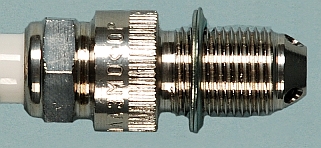
As can be seen on the graphs of the previous page, the plasma injection plug operates on a very different principle from the normal spark ignition type.
There are several parameters to consider on a modern 4V (12, 16, 20, or 24V) engine.
These are related to the need to control combustion temperatures in an around the lambda =0.8 to 1.0 values.
With modern fuel injection systems this is usually around the 13.5:1 air to fuel ratio, with some measure of mixture enrichment under acceleration.
At these levels the catalytic convertor is at its most efficient, and this point is usually reached a matter of minutes after warm up.
If however the Fuel-Air ratio is drastically changed towards the leaner end of the spectrum, it first tends to run somewhat hotter, with high Nitrogen oxide content, (which can be damaging to the convertor), and then MUCH MUCH cooler.
It is this ability of the plasma injection plug which causes problems.
The plug is perfectly capable of burning mixtures leaner than 16-18:1, and on top of this continues to give very good power stability and high torque down at these levels.
We have even seen cases of good power stability at below 18:1, which is almost 50% less fuelling.(!)
At such low fuelling levels nitrogen oxide levels drop through the floor, and certain wide band lambda sensors may simply drop off scale...
This comes as a major suprise, because suddenly the normals points of catalytic control, and fuel cut off are being overridden, and the result is a rather jerky driveability with a lot of
hystereses.
This is not a problem on cars running older designs of head, where squish may not be optimal, and where the engine has been specifically constructed to run very lean and give good performance.
It may however give rise to a strange situation, where the plasma plug requires an in depth remap of the ECU, and/or advance curve, as well as a re-design of some major engine components and/or work on the cylinder head, exhaust, and valving, to get the system to work properly under ultra lean combustion conditions.
we are in the proces of evaluating vehicles model by model, and publishing the results here over the next 18 months, so you should check and refer to the plug reference list for applications, to be sure.
You should also notice, that fitment to some new vehicles MAY invalidate the warranty.
This is not a fault of the plug, it's a commercial issue with the OEM manufacturer.
Remember the principal operating condition mode is ULTRA LEAN.
This is a LOT cooler than a normal combustion condition and favours running large engines at very low throttle openings, where normally the part throttle compression ratio is VERY low,- Therefore the engine is running very inefficiently.
Because of the MUCH faster combustion speed running these plugs in these conditions, it becomes possible to run less advance, in very unfavourable running conditions, such as temperatures below -20C, or above +30C ambient and using 3 grades lower RON fuel rating.
This gives spectacular improvements in general running costs for large V8 or V12 engines on 95 Octane, LPG or Bio Ethanol fuels.